
The Photo-Memory Gap
Why modern kids struggle with visual recall and how to bridge the gap through active play.

The Sorting Struggle
Why categorization is the root of logical thought and how to help toddlers organize their world.
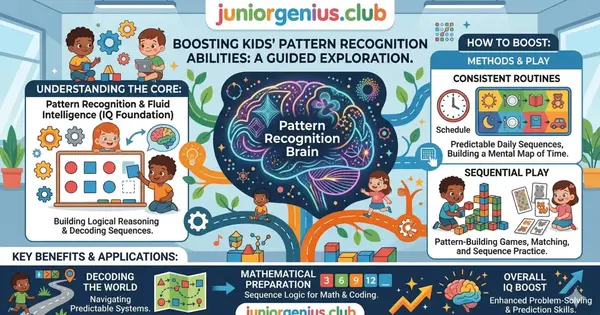
Pattern Recognition
Boosting IQ through visual identification and helping children find the rhythm in their environment.

Spatial Awareness
Helping toddlers understand shapes, quarters, and 3D space in a flat-screen world.

Object Identification
Building early vocabulary through visual association and naming the world together.

The Handwriting Hurdle
Preparing fingers for the pencil and building fine motor strength in a digital world.

Reflex Development
Why speed-based play builds brain connections and neural efficiency in toddlers.

Hand-Eye Precision
Training accuracy in a digital world and mastering precise movement for physical control.

Tapping Timing
Developing rhythmic control, focus, and the internal metronome through purposeful play.

The Path to Literacy
Tracing as a foundational skill for writing, symbol recognition, and academic confidence.

Decoding Faces
Teaching children to read emotional cues and building the foundations of empathy through play.

The Rules of Play
Understanding social boundaries, turn-taking, and the natural flow of cooperative play.

Empathy in Action
Encouraging caretaking behaviors and nurturing compassion in early childhood development.

Focus in Chaos
Building the ability to concentrate and maintain focus in distracting or noisy environments.

Social Discovery
The joy of finding "hidden" friends and the cognitive leap of object permanence.

Healthy Digital Habits
Safe scrolling and active engagement strategies to avoid the "YouTube rabbit hole."

The Resilience Factor
Using puzzles and productive struggle to build the Adversity Quotient and grit.

Nature's Rhythm
Teaching patience and delayed gratification through the steady cycle of natural growth.

Numerical Foundations
Making counting a physical and visual habit to bridge the gap to abstract math.

Time Perception
Helping toddlers grasp the concept of "when" and understand the flow of their day.

Auditory Intelligence
The link between sound identification and language acquisition in early childhood.

The Concept of Home
Matching animals to their natural habitats to build taxonomic and logical reasoning.

The Science of Color
Interactive learning of primary and secondary colors through digital and physical play.

The Logic of Utility
Understanding how we categorize everyday items to build organizational intelligence.

Pattern & Color Logic
Advanced sorting through color-coded systems to sharpen predictive accuracy.

The Digital Easel
Building creative confidence and fine motor control through digital color exploration.

Abstract Articulation
How free-form drawing prepares the brain and hands for the complex task of writing.

The Art of Celebration
Using interactive feedback to boost self-esteem and foster a love for learning.

Nature’s Canvas
Understanding growth and patience through the steady rhythm of digital gardening.

Precision in Play
Refining the "pincer grip" through swipe and scrub-based digital interactions.

The Silhouette Secret
Mastering abstract shape recognition and building mental templates for visual logic.

Part-to-Whole Geometry
The logic of puzzles and spatial assembly to support future literacy and math.

Taxonomic Thinking
Classifying animals by their homes to foster ecological awareness and scientific inquiry.

The Grid Master
Advanced strategies for visual memory using grid-based coordinate mapping.

The Logic of Inclusion
Identifying the 'Odd One Out' to build precise categorization and deductive reasoning.

The Anticipation Game
Predicting movement and timing to build predictive accuracy and strategic thinking.
Precision Under Pressure
Developing calm accuracy and hand-eye coordination in fast-paced environments.
Neural Speed Mastery
Boosting neural efficiency and reflex development through fast-twitch brain responses.
The Attention Anchor
Building sustained focus and concentration in distracting environments.
Rhythm and Pulse
Developing an internal metronome and rhythmic timing for coordination and self-regulation.
Emotional Literacy
Giving a face to the feelings inside and building the foundations of EQ through play.
Social Interaction Logic
Observing cause and effect in character movement to decode social dynamics.
Auditory Identification
The link between sound identification and language acquisition in early childhood.
Object Permanence
The cognitive leap of the 'Hidden Friend' and the foundation of memory and security.
Contextual Naming
Building vocabulary through visual guessing and linking symbols to language.
The Science of Color Mixing
Interactive learning of primary and secondary colors through logical experimentation.
Circadian Understanding
Teaching the cycle of Day and Night to build healthy rhythms and sleep habits.
Temporal Foundations
Introduction to the concept of hours and minutes to master the flow of time.
Nutritional Logic
Categorizing food and understanding animal needs to foster empathy and health.
Sequential Logic
Beyond counting—understanding numerical order and the power of what comes next.

The Magic of Sensory Play: Why Digital Sand Promotes Calm
Discover why sensory play like digital sand is critical for calming anxious toddlers and building fine motor mastery in a chaotic world.
Refining the Pincer Grip: How Tracing Paths Shapes Tiny Hands for Writing
Learn how interactive tracing paths help toddlers refine their pincer grip, paving the way for confident handwriting and fine motor mastery.
The Satisfying Snap: The Surprising Fine Motor Benefits of Bubble Popping
Explore how simple popping interactions build targeted finger strength, hand-eye coordination, and sensory satisfaction in toddlers.
Cause and Effect: Teaching Action and Reaction Through Hatching Surprises
Understand why cause-and-effect play is fundamental to logical reasoning and how 'hatching' interactions build confidence and persistence.
Calming the Mind: The Role of Visual Sensory Feedback in Regulating Energy
Discover how gentle, fluid visual feedback can help toddlers transition from high-energy chaos to a focused, regulated state.
Finding the Beat: Why Rhythm Exploration is Crucial for Early Language Skills
Understand how rhythm and beat exploration lay the groundwork for language acquisition and fluent speech in early childhood.
Musical Foundations: The Cognitive Benefits of Playing Early Scales
Discover how introducing musical scales to toddlers boosts auditory memory, spatial reasoning, and emotional expression.
Connecting Sound to Meaning: Early Auditory Identification and Recall
Learn why identifying and recalling environmental sounds is a crucial step in cognitive development and early vocabulary building.
The Rhythmic Brain: How Identifying Beats Improves Motor Coordination
Explore the fascinating connection between rhythmic awareness, internal timing, and gross motor coordination in young children.
Auditory Memory: Recognizing and Recalling Environmental Noises
Discover how training a child to recognize and recall environmental noises builds working memory, safety awareness, and focus.
The Science of Scale: Teaching Toddlers the Logic Behind Big and Small
Understand how the concepts of 'big' and 'small' form the foundational logic for abstract mathematics and proportion.
Temperature Logic: Introducing Hot and Cold Associations Safely
Learn how categorizing items by temperature helps toddlers understand abstract associations and early scientific principles safely.
Environmental Sorting: Understanding Land, Sea, and Air Habitats
Explore how sorting animals and vehicles by their environments builds foundational scientific knowledge and complex categorization skills.
Beyond Colors: The Power of Categorizing by Physical Attributes
Discover why moving beyond basic color sorting to categorizing by physical attributes like texture, shape, and weight boosts a child's analytical skills.
Early Scientific Method: Cultivating Observation and Environmental Association
Learn how encouraging toddlers to observe and associate objects with their environments lays the groundwork for the scientific method.
Mindful Breathing: Teaching Actionable Self-Regulation to Preschoolers
Learn how visual breathing exercises can help toddlers manage anxiety, tantrums, and big emotions independently.
Navigating Big Feelings: Helping Kids Identify and Validate Emotions
Discover how helping toddlers identify facial expressions and name their emotions builds the foundation for lifelong emotional intelligence.
Visualizing Calm: How Breath Control Reduces Tantrum Frequency
Dive deeper into the mechanics of tantrum reduction by pairing visual cues with active breath control for toddlers.
Empathy in Action: Reading the Room Through Facial Expressions
Understand why the ability to read facial expressions is the cornerstone of empathy and how to help your toddler develop social awareness.
The EQ Advantage: Building Emotional Intelligence Before Kindergarten
Learn why Emotional Quotient (EQ) is often more critical for school success than IQ, and how to actively build it in the toddler years.
The Order of Things: Why Sequential Logic is the Bedrock of Coding
Discover how teaching toddlers simple sequencing builds the exact logical framework required for future computer programming.
Understanding 'Before' and 'After': Temporal Concepts for Toddlers
Learn how teaching the concepts of 'before' and 'after' helps toddlers grasp the abstract nature of time and improves behavioral compliance.
The Visual Schedule: Reducing Anxiety Through Predictable Sequences
Discover how using visual sequences for daily routines drastically reduces toddler anxiety and eliminates power struggles.
Pattern Prediction: How Anticipation Builds Working Memory
Understand how predicting visual and auditory patterns exercises the working memory and improves overall cognitive capacity.
The Logic of Routine: Turning Chaos into Predictable Outcomes
Explore how establishing a logical, predictable routine fosters independence and teaches children cause and effect on a macro scale.

Filtering the Noise: The Importance of Selective Attention
Learn why selective attention is crucial for learning in distracting environments.
Visual Scanning: Finding Hidden Details and Enhancing Observation
Enhance your childs observation skills through targeted visual scanning exercises.
The Concentration Muscle: How to Build Focus
Build your childs focus and concentration through goal-oriented digital play.
Discovery in the Dark: Encouraging Curiosity
Encourage curiosity and eliminate fear of the dark through guided discovery play.
Quick Decisions: Sharpening the Mind Through Fast Action
Sharpen your childs mind and decision-making skills with focused, fast-action play.
The Anticipation Gap: Catching Falling Objects
Teach the brain to anticipate and catch falling objects, improving coordination.
Fast-Twitch Fun: Safely Improving Reaction Times
Improve reaction times safely and effectively in young children through targeted play.
Spatial Trajectory: Understanding Moving Objects
Help toddlers understand spatial trajectories and where moving objects will land.
The Eye-Tracking Challenge: Erratic Movement Patterns
Develop crucial eye-tracking skills by following erratic movement patterns.
Dynamic Precision: Turning Speed into Accurate Action
Turn speed into highly accurate action through dynamic precision exercises.
One-to-One Correspondence: The Secret First Step to Math
Discover the secret first step to early math: mastering one-to-one correspondence.
Sequential Counting: Following the Number Path
Learn how to help your child follow the number path without skipping.
Visual Numeracy: Moving Beyond Rote Counting
Move beyond rote memorization and develop true visual numeracy in your child.
The Number Line in Practice: Connecting Math to Shapes
Connect mathematical order to visual shapes for a deeper understanding of the number line.
Math Without Tears: Gamifying the First Numbers
Gamify the first numbers for better retention and a tear-free math learning experience.
Early Physics: Understanding Temperature Changes
Understand temperature changes through fun categorization activities for toddlers.
Taxonomic Mastery: Where Vehicles and Animals Belong
Achieve taxonomic mastery by learning exactly where vehicles and animals belong.
Cause, Effect, and Chemistry: The Science of Baking
Explore the foundational science of baking, focusing on cause, effect, and chemistry.
Exploring the Elements: Safely Categorizing the World
Safely categorize the expanding world around us by exploring the fundamental elements.
Sensory Science: Connecting Touch and Temperature
Connect touch and temperature logically through engaging sensory science activities.
The Reward Loop: How Positive Feedback Builds Confidence
See how immediate positive feedback creates a reward loop that builds confidence.
Calming Chaos: Using Safe Digital Environments
Use safe digital environments to help your toddler decompress and calm the chaos.
The Joy of the Pop: Sensory Satisfaction and Stress Relief
Experience the sensory satisfaction and stress relief of popping for childhood development.
Anticipation and Reward: The Psychology of Safe Surprises
Understand the psychology of safe surprises and how anticipation enhances learning.
Mindful Creativity: Unstructured Play for Cognitive Rest
Promote cognitive rest and mindful creativity through unstructured digital play.